Review by Craig Postlethwaite
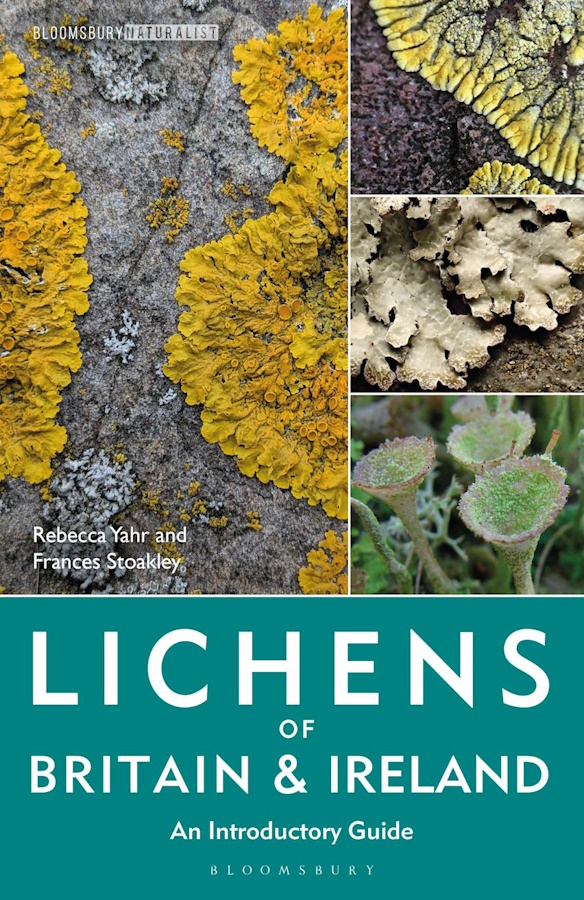
Publisher: Bloomsbury, 2025
ISBN: 9781399404747
Hardback, 256 pp, £22.50 (available for less at many booksellers)
This is a new book published at the end of 2025 aimed at those who want a simple introduction to lichens. Both writers are based at the RBGE and Beccy Yahr is a past president of the British Lichen Society and one of the top lichenologists in the country.
The approach of the book is to avoid using too many technical terms or to push people in to more challenging aspects of lichenology such as the use of chemicals.
There is an initial introduction to lichens where the often used jam tart analogy for apothecia is discussed. The use of a tea cake as an analogy for perithecia is new however and is very appropriate. This introductory section runs to over forty pages and explains what lichens are and how they work and the main structural features of them in a clear and easily understandable way. Photographs are frequent and well selected to illustrate points within the text.
There then comes what is the most useful part of the book for beginners. The authors provide three “pathways” to identification of a lichen. These are habitat, a baker’s dozen of key groups, and finally form and colour. Depending on the readers preference they can move through one of these pathways on to the detailed lichen descriptions. The habitat pathway is probably easiest for complete beginners with the other two providing quicker methods to reach a likely identification.
The species accounts are sorted by form (Fruticose, foliose, crustose) and then colour. At the start of each form section photographic contents pages allow quick determination of where the most likely candidate lichen will will be. The accounts themselves have excellent photos and descriptions using clear and sensible language. Points to look for are clearly highlighted and similar species are given some space and comment.
The book covers 133 species. This is less than 10% of the species in Britain and Ireland and some very common species are missing. However that absolutely does not detract from the value of the book. The species selected are those that are possible to identify by sight alone or by use of a hand lens and as such will be those that will be of interest to beginners. The book often, and of course correctly, states that many lichens specimens can’t be identified, even by experts. Where common species are left out (e.g. Lecidella scabra) it is because those species are very variable and/or require the use of chemicals or microscopy to accurately identify.
This book wonderfully fills a huge hole in the literature for the study of British lichens. Until this book there were no entry level guides for naturalists or others who may have only a casual interest in lichens. This book allows anyone who is willing to take a little time the ability to identify a good number of lichens they are likely to see. It is, refreshingly, slightly biased towards lichens that occur in Scotland and the West of the UK rather than the South East of England bias that happens in so many books across many taxa. The book is strongly recommended as a starting point for anyone with an interest in Lichens.
 Paisley Natural History Society
This sounds like a very good introduction both for myself and family members with an interest in lichens.
LikeLiked by 1 person
I concur whole-heartedly with Craig’s assessment of the book. Yesterday I managed to identify half a dozen lichen photos we’ve had for ages in just a couple of hours, after reading the intro and learning how to use the various routes into ìdentifying them. Thank you Craig for the recommendation. Anne P
LikeLiked by 1 person