
Saturday 15th February 2025
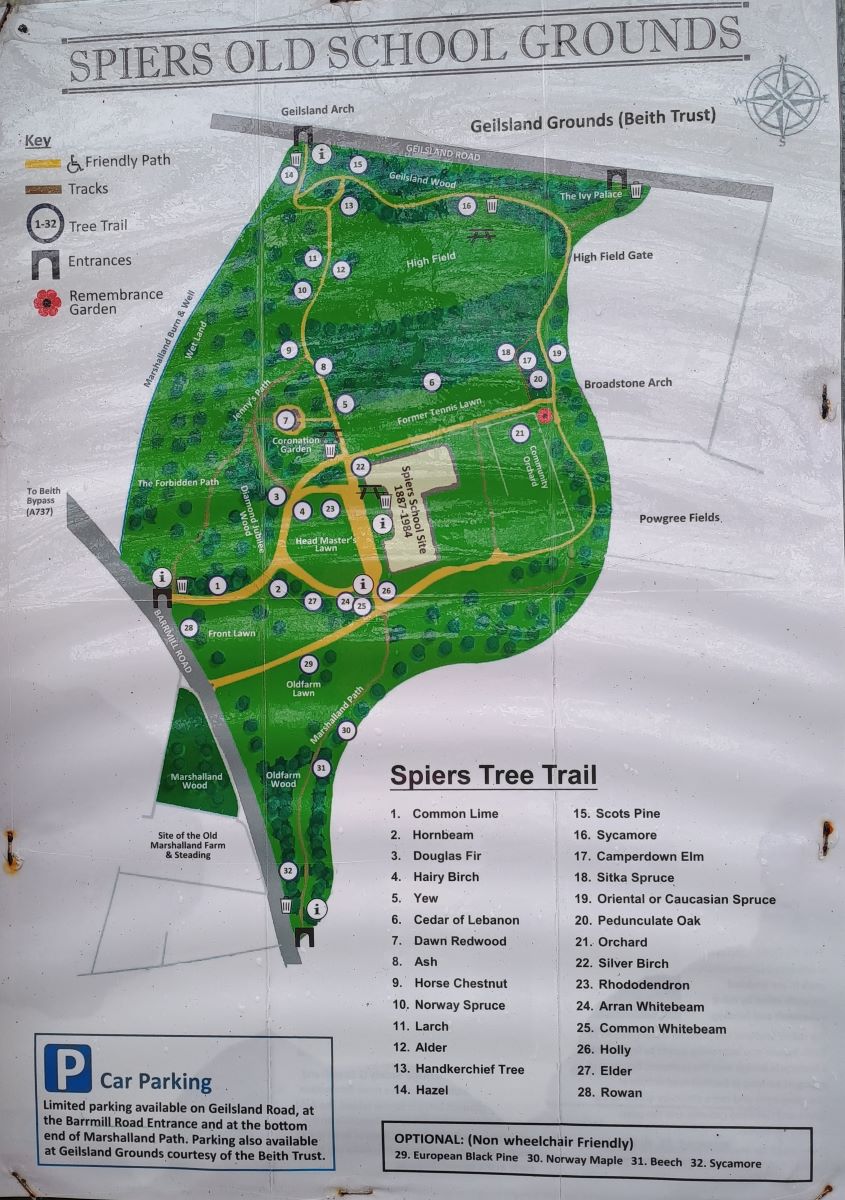
A change from our usual winter tree walk in woodland plantations, this year we went to the grounds of the Old Spier’s School in Beith, which has more mature formal planting and some challenging, unusual species. Fortunately, there is a tree trail map and we had the invaluable help of Simon Stuart and his vast tree knowledge to keep us right. It was bitterly cold and had started to snow but everyone was well wrapped up against the weather.
We started in the carpark of Geilsland Estate with a bit of background information about the School. It had been built with a legacy of the Spiers family as a charitable school in 1887. The 16.5 acre grounds were designed and laid out at that time by the Head Gardener of Eglington Castle, with a walled garden and arboretum with 50-100 varieties of trees. Although the school closed in 1972 and was demolished in 1984 many of the original planting remains. A restoration programme was started in 2010 and the grounds are now listed by the Royal Caledonian Horticultural Society as an important designed landscape.

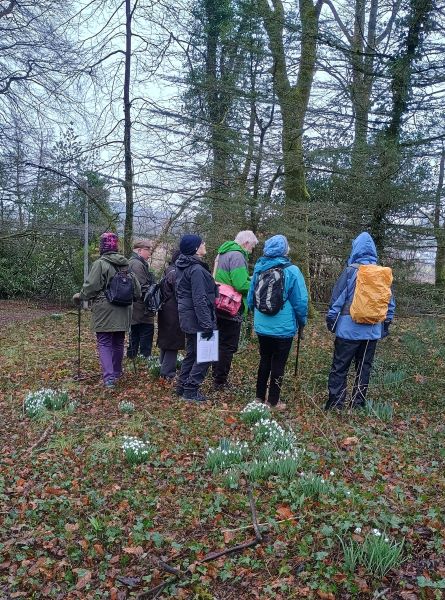
As, we walked through Geilsland Estate towards the School grounds we were waylaid by several interesting trees we hadn’t encountered on previous walks. A Lime tree was identified from its zig-zag stems with bright red alternate buds and epicormic growth (where masses of stems grow out from the base of the tree). Examining the stems more closely, the upper side was red but underneath, on the shady side, the stems were green. The next tree was more of a challenge, until we realized that there were four different trees sending out shoots from one spot. So, it always pays to check several stems for ID!
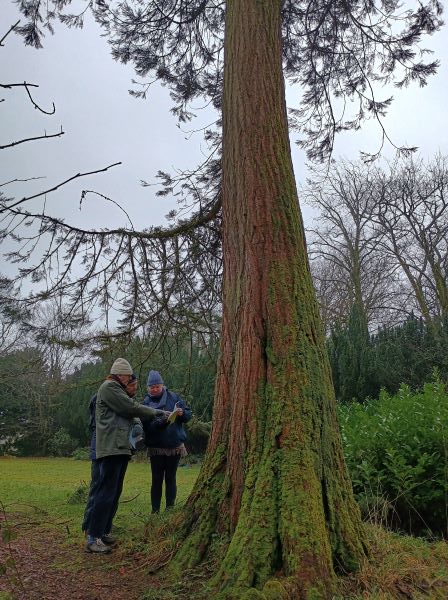
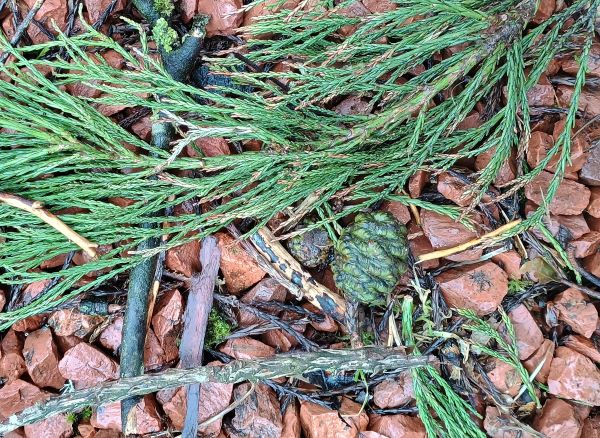
We encountered several conifers on our walk and while they mostly keep their leaves in winter, and should be easy to identify, we were unfamiliar with them. An impressive row of Irish Yew and Snowdrops led us to a Smooth Arizona Cypress. Following Simon’s suggestion, we crushed its leaves and were amazed by the distinctive grapefruit smell released. We then spent some time examining a Giant Sequoia (a Redwood, also known as Wellingtonia), characterized by its spongy red bark, tall straight trunk and small compact cones. At the roadside, we encountered a tree with black buds. It had alternate buds, so wasn’t the black-budded Ash that we were familiar with, but a Wych Elm.
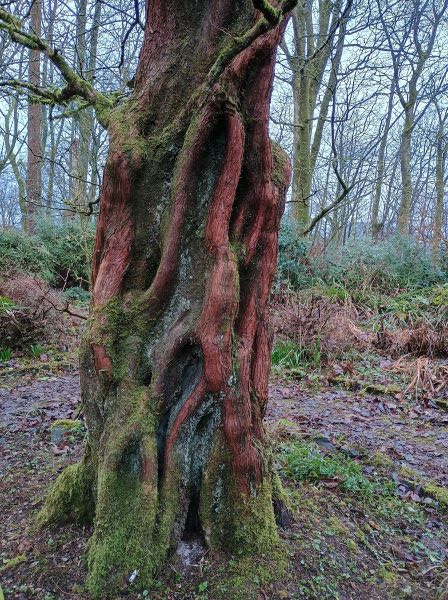
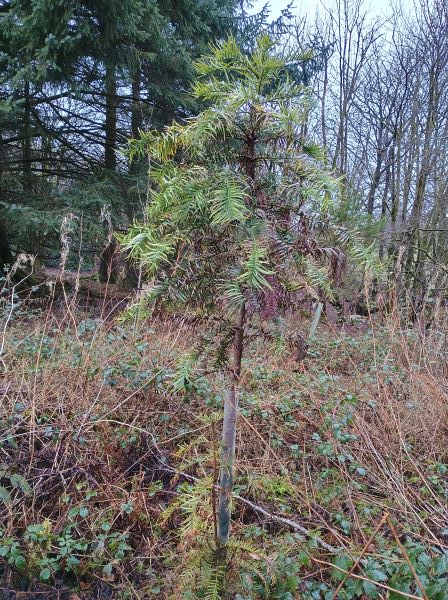
Once we reached the entrance to the Spier’s School grounds it had stopped snowing, but was still bitterly cold and not conducive to spending a lot of time standing still to identify trees. For those we weren’t sure of, we decided to make a return visit in the summer rather than risk frostbite! Some of the more notable trees we encountered in the grounds included two ‘fossil’ trees. The Dawn Redwood was known from fossils but thought to be extinct until 1946 when living species in China were identified. Within a few years this deciduous conifer was being planted in arboreta around the world. The tree at Spier’s is one of these early samples having been planted in 1953 to celebrate the coronation of HRM Queen Elizabeth II. It is a remarkable tree with sinewy, red trunk, sharply tapering to the top. Similarly, the Wollemi Pine, more recently planted at the School, is known from fossils to have existed at the time of the dinosaurs. It was also thought to be extinct until it was discovered in Australia in 1994 and is a critically endangered species.
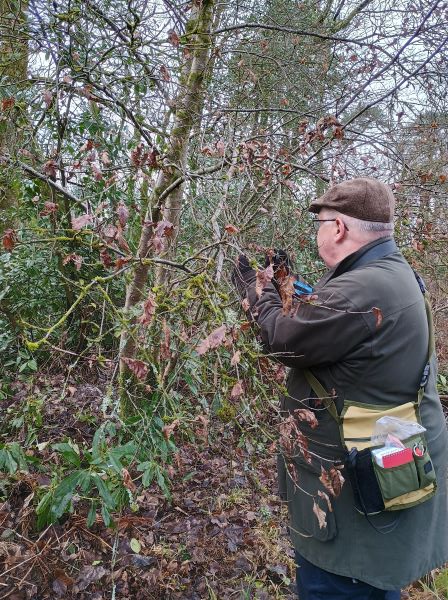
Another deciduous conifer we examined was the Larch. This one was thought to be a hybrid between the European Larch (where the scales on the cones are straight) and the Japanese Larch (where the scales on the cones curl back on themselves). As always, hybrids were giving us problems in identifying some trees. Tree 22 on the trail map was listed as a ‘Silver Birch’ but Simon’s expert eye pointed out that it didn’t have a weeping habit and the twigs were downy with a few white lenticels and not hairless with lots of lenticels. It was concluded that although it had a distinctive silvery bark, it was more likely to be a hybrid of the Silver and Downy Birch. I won’t even go into the problems we had with hybrid Willows! Spier’s School also has an example of the rare and endangered Arran Whitebeam (a hybrid of the Rock Whitebeam and Rowan) which is endemic to the Island of Arran. It was planted next to a Common Whitebeam and both were still holding withered leaves on their branches, so we could compare the pinnately lobed Arran species with the unlobed Common species.


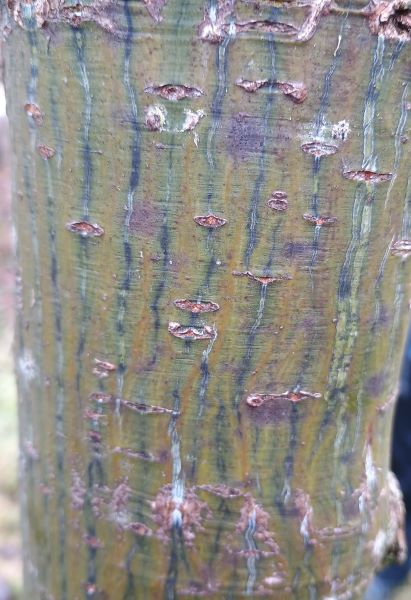
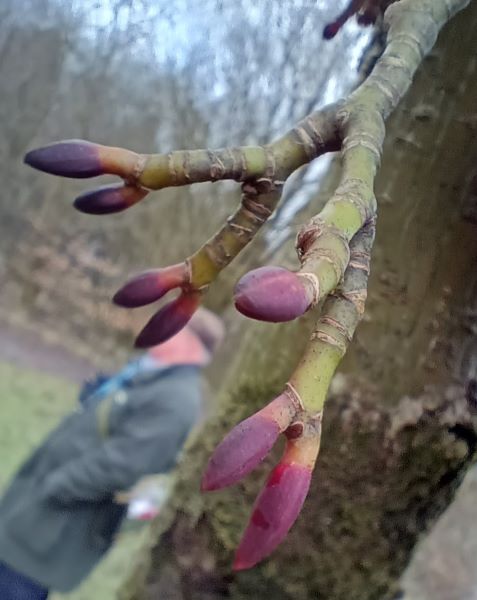
By this time half our party had retreated to the welcoming warmth of Mocha Jak’s Coffee Shop back at Geisland. As the rest of us headed back to join them, we couldn’t help being distracted by trees on the way: the Snake Bark Maple (was it a Red Snake Bark or a Pere David Maple – we couldn’t decide!) with its remarkable patterned bark and red buds; the Norway Maple with buds shaped like a Sycamore but bright red in colour.
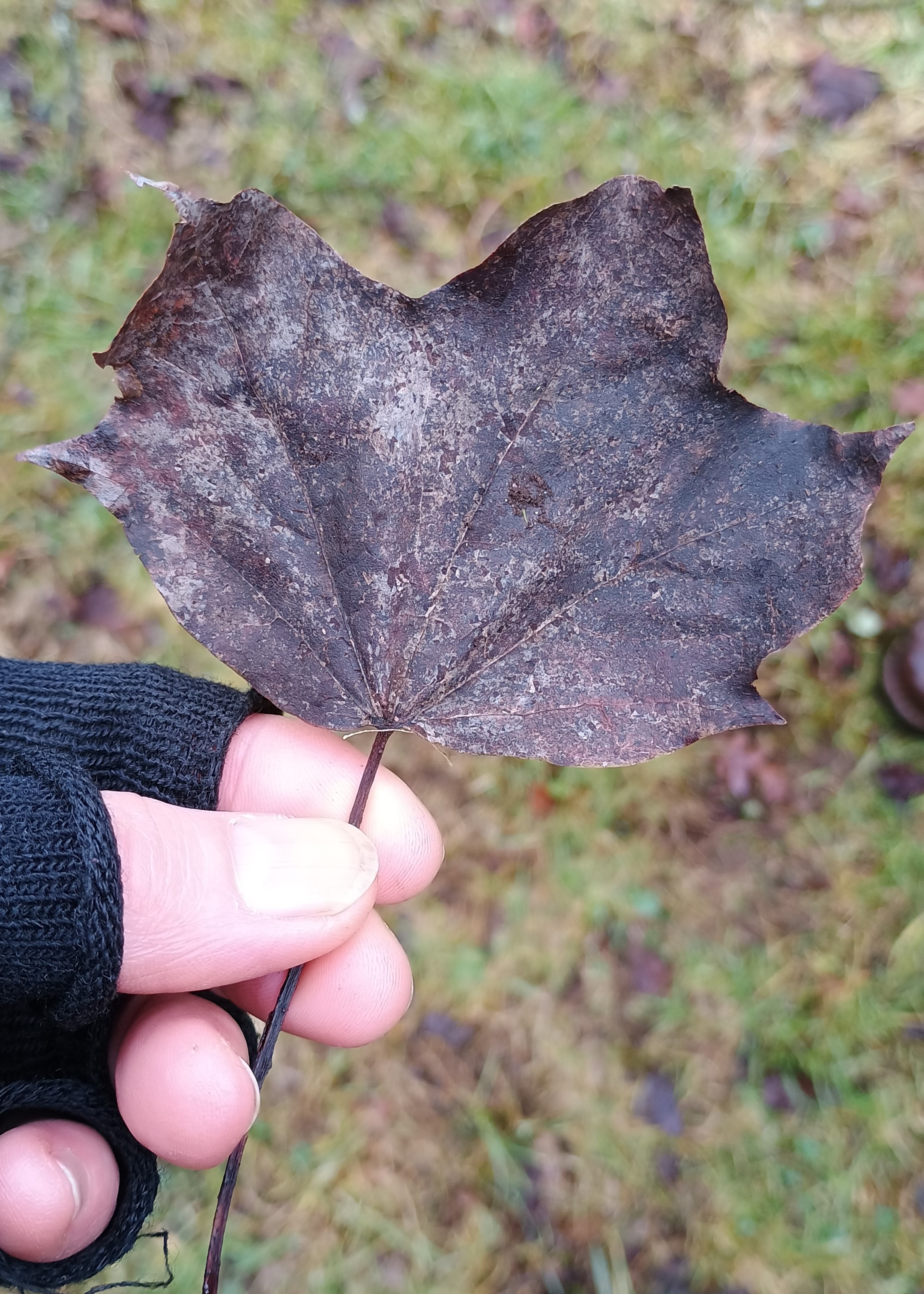

We kept finding the distinctively shaped leaves of Turkey Oak scattered on the ground. It was only at the last minute that we managed to find the actual tree, confirmed by the presence of the remains of the whiskery acorn cups on the ground under the tree. Content with ending on a high, we joined the rest of the party in the café to defrost with hot soup and snacks.
Report and photographs by Kirsty Menzies
With many thanks to Simon Stuart for helping to lead the walk and making it so much more interesting. Thanks also to Craig Postlethwaite who, not surprisingly, was distracted by lichens and birds and provided a species list for us.
Download a printable pdf of the report.
Field guides used
Field Studies Council, Photo guide to Trees in Winter, copies provided for the group courtesy of Trees for Cities / Clyde Climate Forest
Field Studies Council, Broad-leaved trees and shrubs in winter – a good introduction to winter tree ID. The key is really easy to use and covers over 70 of our most common species
BSBI, The Field Key to Winter Twigs – more technical but very comprehensive, with photographs of twigs and buds
Collins Tree Guide – a general guide to trees with illustrations
Woodland Classroom – winter tree id guide
Discover the Wild – winter tree buds
Species List
Plants
Alder (Alnus glutinosa)
Ash (Fraxinus excelsior)
Beech (Fagus sylvatica)
Birches and hybrids of: Silver Birch (Betula pendula); Downy Birch (Betula pubescens)
Bramble (Rubus fructicosus agg.)
Cedar: Japanese Red Cedar (Cryptomeria japonica)
Cypresses: Smooth Arizona Cypress (Cupressus arizonica var. glabra); Dawn Redwood (Metasequoia glyptostoboides)
Elm: Wych Elm (Ulmus glabra)
Firs: Grand Fir (Abies grandis); Douglas Fir (Pseudotsuga menziesii)
Hazel (Coryllus avellana)
Holly (Ilex aquifolium)
Horse Chestnut (Aesculus hippocastanum)
Larch and hybrids of: European Larch (Larix decidua) and Japanese Larch (Larix kaempferi)
Lime (Tilia sp.)
Maple: Sycamore (Acer pseudoplatanus); Norway (Acer platanoides); Snake Bark Maple (Possibly Acer capillipes)
Oak: Pedunculate (Quercus robur); Turkey Oak (Quercus cerris)
Redwood: Giant Sequoia (Sequoiadendron giganteum)
Snowdrop (Galanthus nivalis)
Whitebeams: Common (Sorbus aria); Arran (Sorbus arranensis)
Willows and hybrids of: Goat Willow (Salix caprea), Grey Willow (Salix cinerea)
Wollemi Pine (Wollemia noblis)
Yew: Irish Yew (Taxus baccata ‘Fastigiata’)
Fungi
Elf cup – Ruby or Scarlet (Sarcoscypha coccinea / Sarcoscypha austriaca)
Lichens
Arthonia radiata
Caloplaca citrina s. lat.
Cladonia coniocraea
Cladonia fimbriata
Evernia prunastri
Fuscidea lightfootii
Glaucomaria carpinea
Graphis scripta s. lat.
Hypogymnia physodes
Hypogymnia tubulosa
Hypotrachyna revoluta s. str.
Lecanactis abietina
Lecanora campestris Lecanora chlarotera
Lecanora expallens
Lecidea lithophila
Lecidella elaeochroma f. elaeochroma
Lepraria finkii
Lepraria incana
Melanelixia glabratula
Melanelixia subaurifera
Parmelia saxatilis
Parmotrema perlatum
Peltigera hymenina
Peltigera membranacea
Pertusaria leioplaca
Phlyctis argena Physcia tenella
Porpidia tuberculosa
Protoblastenia rupestris
Protoparmeliopsis muralis
Punctelia subrudecta s. str.
Ramalina farinacea
Ramalina fastigiata Ramalina fraxinea Rhizocarpon reductum Usnea subfloridana Xanthoria parietina
Birds
Blackbird (Turdus merula)
Blue Tit (Cyanistes caeruleus)
Bullfinch (Pyrrhula pyrrhula)
Carrion Crow (Corvus corone)
Chaffinch (Fringilla coelebs)
Dunnock (Prunella modularis)
Feral Pigeon (Columba livia f. domestica)
Goldcrest (Regulus regulus)
Great Tit (Parus major)
Great Spotted Woodpecker (Dendrocopos major)
Herring Gull (Larus argentatus)
Jackdaw (Coloeus monedula)
Magpie (Pica pica)
Robin (Erithacus rubecula)
Siskin (Spinus spinus)
Starling (Sturnus vulgaris)
Woodpigeon (Columba palumbus)
 Paisley Natural History Society