Review by Simon Stuart (originally published in the Native Woodland Discussion Group Newsletter, and re-used with kind permission)
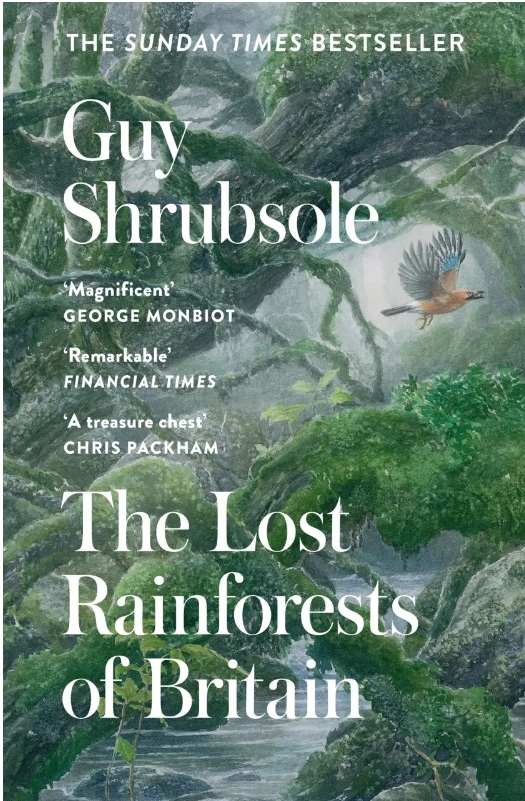
In this eagerly anticipated book, the author gives an often very personal but informative overview of the current state of Britain’s temperate rainforests, discusses their historical (and current) decline and the main factors affecting their survival and expansion.
If the content seems a little Southwest English and sheep centric it is only to be expected as the author and partner moved to Devon in 2020 and only then became aware of the existence of Britain’s temperate rainforests.
However, the international importance and vulnerability of temperate rainforests is covered in the first chapter and returned to when discussing bringing back the rainforests. The British wide aspect of rainforests is brought in by trips around the country to Wales, the lake district and Scotland, meeting with local experts and/or enthusiasts in each area while visiting rainforests sites.
The two chapters focusing on Scotland contain some weel-kent faces, with Ben and Alison Averis featuring in both, Gordon Gray Stephens (along with badger sporran) and Ian Dow making appearances in the second and Brian and Sandy Coppins also getting a name check. Other things appearing more prominently in the second Scottish chapter roughly two thirds into the book are deer and rhododendron which may have made brief appearances up until then but take centre stage here. The authors take on both problems I feel is also a little simplistic, true certain sporting estates could do more about control of red deer perhaps, but numbers of roe deer are also very high across the country and are probably more difficult to control. I also suspect that if sheep are eventually excluded from the woodland remnants around his home, the author might find deer being a more difficult problem to solve here as well. Rhododendron has now expanded beyond the bounds of the original shooting estates that used it for cover as well as the gardens it was also introduced into, as well as estates being sold and broken up making the ‘polluters’ pay model a little more problematic to implement. Landowners do indeed have a very important part to play in dealing with both of these issues, but perhaps we should be looking at it in a more targeted and collaborative way?
One of most interesting features of the book is the interplay between people and the rainforest, whether this is in myths and legends, literature, placenames, crazes such as ‘fernmania’ or changes in land use patterns, effect the rainforests and they also can affect how people view the rainforest. A Gordon Gray Stephens quote at the end of the forest people sums it up, ‘you can’t restore a rainforest without people’. There are some memorable lines within this book, I’m not sure if Oliver Rackham, George Peterken and John Rodwell have ever been described as druids before but it did fit within the context of the narrative. My mind then started to think about possible Scottish examples, Chris Smout, Fiona Watson, tree hugging champion Alistair Firth?
Some readers may find references to issues such as sheep farming, plantation forestry and large landowners a little confrontational, but this does open opportunities for discussions. I for one would like to explore the statement about serried ranks of conifers with bark too acidic for rainforest plants to thrive. Both of Plantlife’s guides to Lichens of Scotland’s Rainforest are for species growing on mildly acidic (Lobarion group) and very acidic (Parmelion group) tree bark. The fact is that given another couple of hundred years these conifers may well develop a similar epiphytic fauna to the native woodlands, like they do in the temperate rainforest in Northwest America.
A piece on Britain’s rainforests in BBC Wildlife magazine recently described Ben Averis as being bemused but excited about the interest in his field and requests for interviews. If this interest can be harnessed to make a difference to the fate of these important habitats that is all to the good. I believe the main benefit of this book is to bring the plight of Britain’s wet woodlands to a wider audience, if this means taking about temperate rainforest rather than Atlantic woodlands then so be it. However, there are already issues being raised about the ‘rainforest’ branding as technically a lot of these areas would be classified as Oceanic woodlands not rainforest and perhaps this is a discussion to be had once you have convinced people about these habitats’ existence and importance, further education appropriate once interest has been piqued. The plethora of media articles claiming lost rainforests in areas as diverse as the Cairngorms and the South Downs also allows educational opportunities about the specific needs of temperate rainforests (or indeed oceanic woodlands) and why.
Personally, I would like to see more emphasis on collaborative working rather than the confrontational, either-or arguments we often fall into with land use issues and the authors’ (and partners) campaigning background perhaps does show here. There is a balance that should be reached, which may shift depending on political will. Rainforests/ Oceanic woodlands cover such a small fraction of their potential area in Britain that even quadrupling their area would still leave space for other land uses such as forestry plantations and sheep farming. The fact is that we should be working in cooperation with each other and working out solutions together, hence the Alliance for Scotland’s Rainforest (ASR). Perhaps this title is less inclusive than Atlantic Woodland Alliance (AWA) but it does include the rainforest ‘buzzword’ and perhaps a bottom up approach for each region of rainforest in Britain may work best, with communication and idea sharing on a national and international level being established to protect and enhance our temperate rainforest environments. The main emphasis should be identifying the best places for restoration and expansion efforts to be concentrated and the idea of mapping existing fragments is very important as a starting point, there is no point in trying to enhance and expand if you don’t know what you have already. The lostrainforestsofbritain.org website and the work of ASR should help in this regard. Hopefully, increased awareness through this book and the work already being done by organisations such as ASR can help raise the resources required to restore and expand this important habitat.
Publisher: William Collins, 2022
ISBN: 978-0-00-852795-2
Hardback, 336 pp, £20.00.
Paperback, £10.99
Kindle, £5.99.
 Paisley Natural History Society