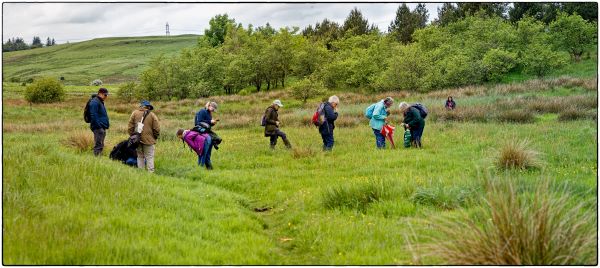
On 25 May 2024, a group of twelve, including insect and plant specialists from both Glasgow and Paisley Natural History Societies, gathered in the south-west car park at Neilston Pad. Known locally as ‘The Pad’, it is an old volcanic plug surrounded by several dams and offers a variety of habitats to explore. The area is used primarily for forestry and we could see that there had been a lot of replanting in the gaps left in 2019 when around 20,000 trees were felled due to Phytophthora ramorum in infected Larch.
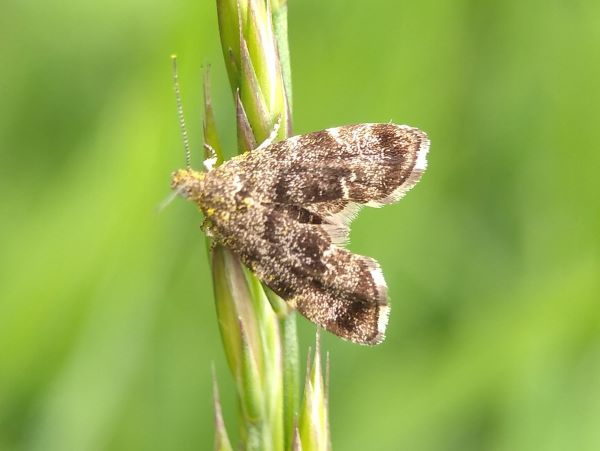
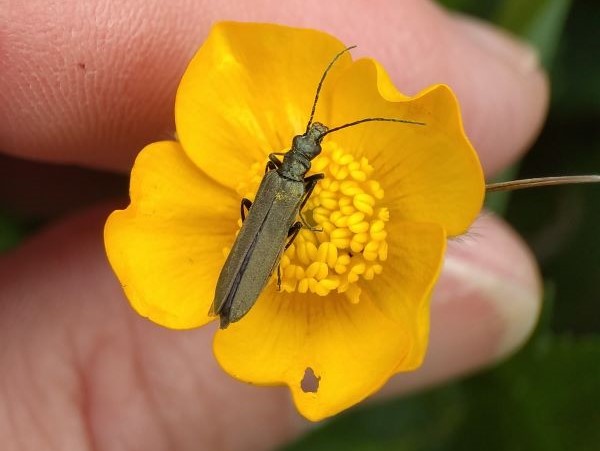
Our outing began with a brief walk through a rather eerie and seemingly lifeless section of the older forest, before breaking out into a green oasis of broadleaved trees and understory. This led out to an area of open grassland where we spent a lot of time examining the wide array of insects, particularly on nettle and buttercups. The day before last had been very wet, but today the sun had come out bringing balmy weather, and a mass of insects. Fortunately, Paul Cobb and Craig Postlethwaite were on hand to help us identify them, including beauties such as the Nettle-tap moth (Anthophila fabriciana), a green False Blister Beetle (Oedemera virescens) and iridescent Green Dock Beetle (Gastrophysa viridula).
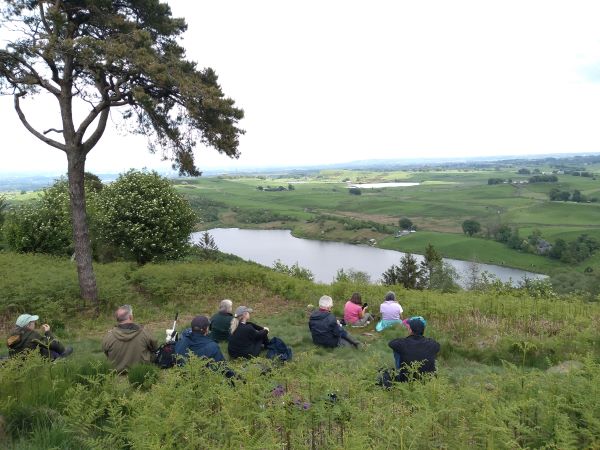
We took the more gently sloping path up The Pad, through beech woodland, to reach the flattened heathland plateau and mixed woodland at the top. We stopped there for lunch with an incredible view of the Snypes Dam and East Renfrewshire countryside. Someone noticed pine cones dropping from the tree under which we were sat. The culprits turned out to be a pair of Common Crossbills (Loxia curvirostra) which soon grabbed everybody’s attention and charmed us with their feeding antics. Then, to cap it all, an Osprey (Pandion haliaetus) flew by us, over the Dam.
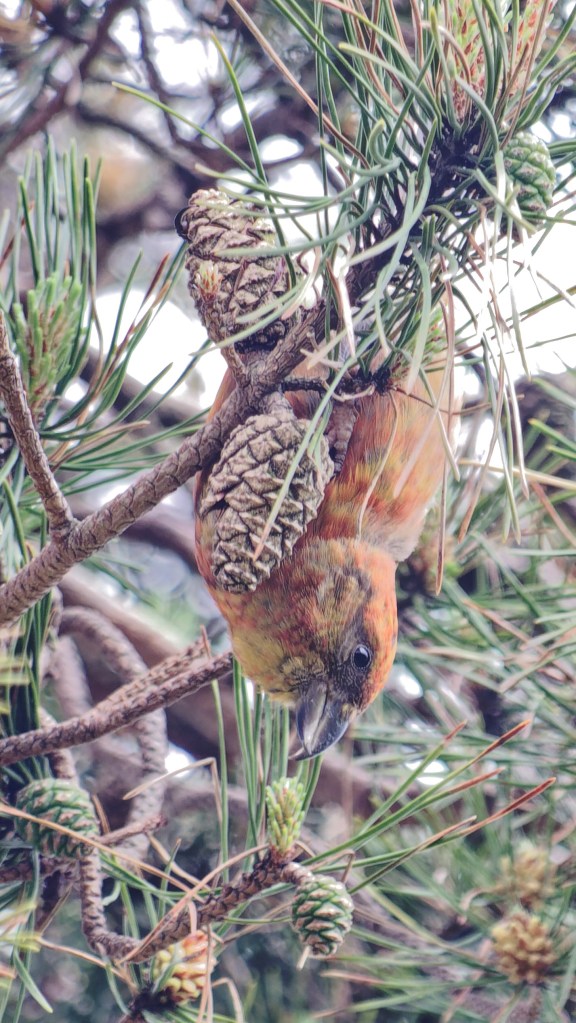
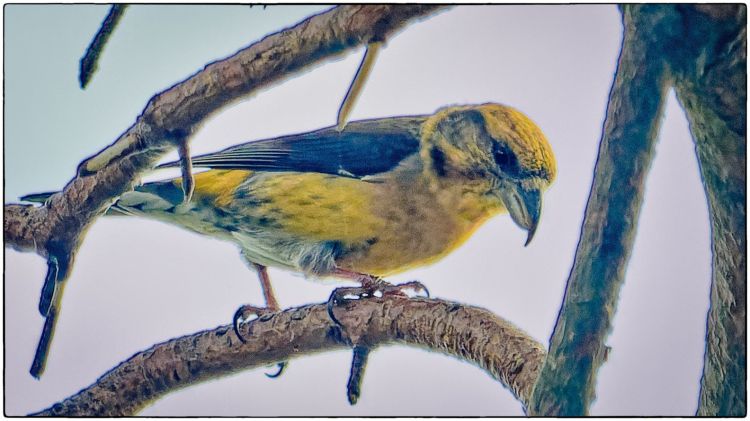
Reluctantly moving on we walked along the track that fringes the eastern edge of The Pad at the base of the steeply wooded slopes of old oak. It offered delightfully dappled shade and followed an old stone dyke, thick with mosses and a lacy fringe of Climbing Corydalis (Ceratocapnos claviculata). On reaching the main track that goes around The Pad we headed back to our cars via the verdant wildflower-filled verges of Harelaw Road. In total we recorded at total of 35 bird species and 23 insect species.
Kirsty Menzies
Bird list recorded by Craig Postlethwaite
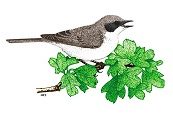
Blackbird (Turdus merula); Blackcap (Sylvia atricapilla); Black-headed Gull (Chroicocephalus ridibundus); Blue Tit (Cyanistes caeruleus); Buzzard (Buteo buteo); Carrion Crow (Corvus corone); Chaffinch (Fringilla coelebs); Common Crossbill (Loxia curvirostra); Dunnock (Prunella modularis); Garden Warbler (Sylvia borin); Goldcrest (Regulus regulus); Goldfinch (Carduelis carduelis); Great Tit (Parus major); Greenfinch (Chloris chloris); House Martin (Delichon urbicum); House Sparrow (Passer domesticus); Little Grebe (Tachybaptus ruficollis); Magpie (Pica pica); Mallard (Anas platyrhynchos); Meadow Pipit (Anthus pratensis); Mute Swan (Cygnus olor); Osprey (Pandion haliaetus); Robin (Erithacus rubecula); Rook (Corvus frugilegus); Sand Martin (Riparia riparia); Sedge Warbler (Acrocephalus schoenobaenus); Song Thrush (Turdus philomelos); Sparrowhawk (Accipiter nisus); Stonechat (Saxicola rubicola); Swallow (Hirundo rustica); Tufted Duck (Aythya fuligula); Whitethroat (Curruca communis); Willow Warbler (Phylloscopus trochilus); Woodpigeon (Columba palumbus); Wren (Troglodytes troglodytes)
Insect list recorded by Paul Cobb, Craig Postlethwaite and Kirsty Menzies
Anthophila fabriciana – Nettle-tap moth; Athous haemorrhoidalis – a click beetle; Cantharis nigricans – a soldier beetle; Cantharis pellucida – a soldier beetle; Cloeon simile – Lake Olive Mayfly; Coenagrion puella – Azure Damselfly; Empis tessellata – a dagger fly; Enallagma cyathigerum – Common Blue Damselfy; Gastrophysa viridula – Green Dock Beetle; Glyphipterix simpliciella – Cocksfoot moth; Oedemera virescens – False Blister Beetle; Orchestes fagi –Beech leaf-miner weevil; Phaedon tumidulus – Celery Leaf Beetle; Phyllobius argentatus – a green weevil; Phyllobius glaucus – a weevil; Phyllobius pomaceus – Green Nettle Weevil; Phytomyza ranunculi – Buttercup Leaf Mining Fly; Pyrrhosoma nymphula – Large Red Damselfly; Rhagio scolopaceus – Downlooker Snipefly; Rhagio tringarius – Marsh Snipefly; Rhagonycha limbata – a soldier beetle; Sialis lutaria – an alderfly; Xanthorhoe montanata – Silver-ground Carpet moth
 Paisley Natural History Society