At our PNHS meeting last Thursday some members raised a couple of intriguing topics that led to lots of discussion and speculation. Before Dan Snowden gave his excellent talk on the RSPB Lochwinnoch nature reserve, we had our usual session for members to talk about their sightings. Ryan Kincaid passed round a couple of logs from a tree which had strange holes spiralling around the bark.
Mysteries
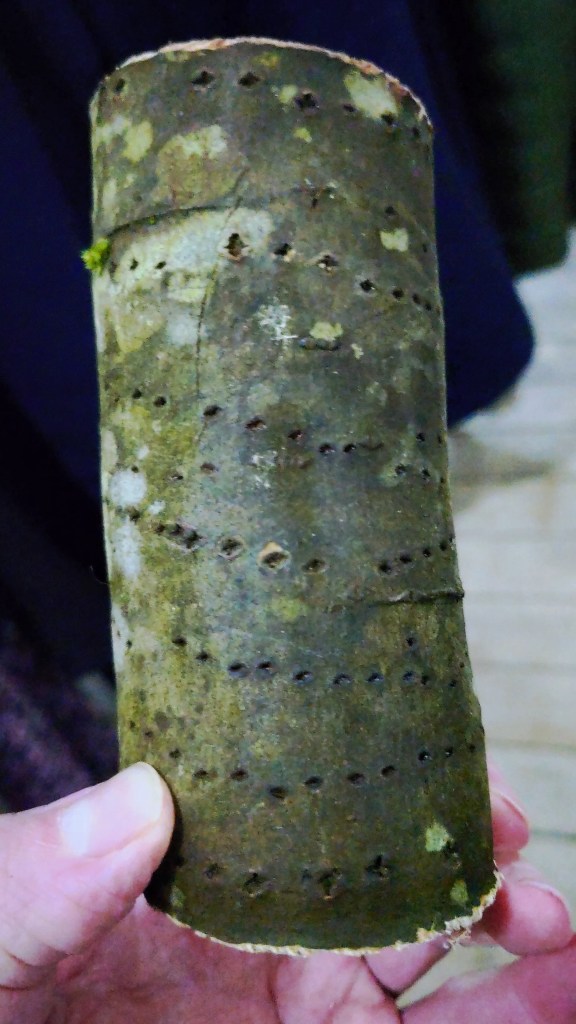
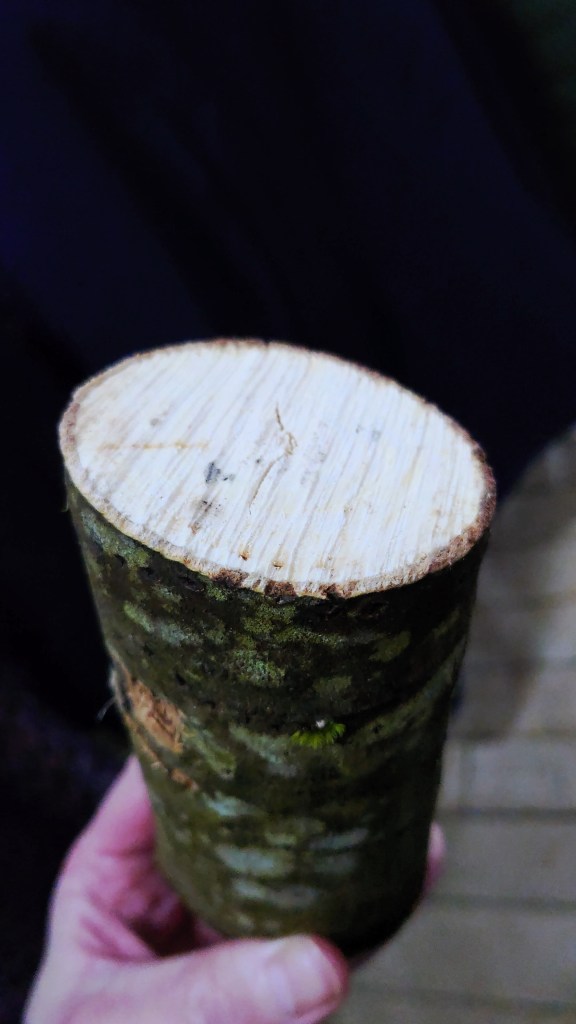
What could have caused these holes?
Some suggestions of possible causes were:
- barbed wire?
- an insect?
- a Treecreeper?
Keep reading and all will be revealed further on.
The next topic was the white bird reported by Kirsty Menzies. It had been seen for a couple of weeks in mid February around the Browside and Boylestone area of Barrhead and her neighbour had captured this photo of it in her garden.
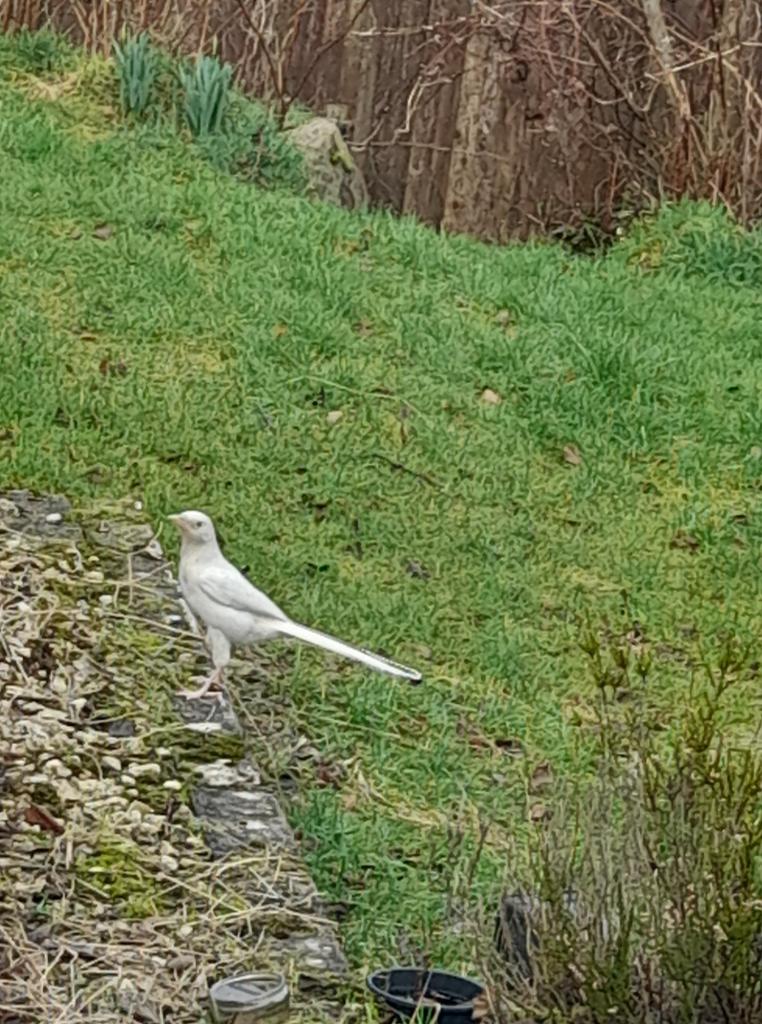
What is this white bird?
Perhaps not such a mystery to anyone who knows birds, as the shape is very distinctive. It is, of course, an albino Magpie.
You can tell it’s an albino because it has no melanin pigments. The feathers are all white, the beak, feet and legs are a pale pinky yellow, and the eyes are red.
Sometimes birds may be leucistic where only some of the feathers are white or faded-looking, but the beak, feet, legs and eyes are usually the normal colour.
Marvels
Albinism is a rare condition caused by a genetic mutation. In a British Trust for Ornithology Abnormal Plumage Survey launched in 2011, records of 3,000 birds with abnormal plumage found 82% to be leucistic and only 3% albino. Of all the records only 34 were Magpies.
Albino birds have poor eyesight and their feathers tend to be weaker, making flight more difficult. Their white feathers also make them stand out and so they are more vulnerable to predators. Sadly, this proved to be true for this Magpie and on 4 March the remains of its feathers were found in the hawthorn scrub at Boylestone.
And as to the mystery holes in the tree…..
Since the meeting, it has now been confirmed by the country park rangers that the holes were in fact caused by a Great Spotted Woodpecker. These birds are well known for making larger holes in trees when they are drumming on them and pecking at the bark to find insects to eat. However, the holes in the log were much smaller than those and formed a very distinctive spiral pattern. Apparently they were made by the woodpeckers drinking sap from the trees. You can read more about the phenomenon in this article by J N Gibbs, ‘Sap-sucking’ by woodpeckers in Britain, from British Birds 76: 109-117, March 1983.
If anyone else has found anything out of the ordinary around Renfrewshire please do let us know.
 Paisley Natural History Society